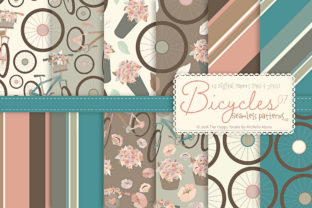
Bicycles - Seamless Patterns Digital Papers
For designers, marketers, educators, and small business owners who regularly produce print-ready collateral or digital assets, finding high-quality, versatile pattern resources can be time-consuming. Bicycles - Seamless Patterns Digital Papers stands out not because it’s flashy or trend-driven, but because it delivers consistent technical execution and thoughtful thematic cohesion—centered around bicycles in a way that feels fresh without leaning into cliché.
What You Actually Get—and Why It Matters
The package includes 12 JPEG files and 12 PNG files—all at 3600 × 3600 pixels (approx. 12″ × 12″), 300 dpi, RGB color mode. That resolution supports professional printing for brochures, packaging mockups, stationery, and fabric swatches without upscaling artifacts. The PNGs include transparent backgrounds, making them immediately usable for web banners, social media overlays, app UI elements, or layered design comps where background flexibility matters.
In addition, there’s one Adobe Illustrator (.ai) file compatible with CS6 and newer, plus an EPS version. These vector-based pattern swatches allow infinite scaling, easy recoloring via global swatches, and integration into brand style guides or production workflows where consistency across formats is non-negotiable. Unlike raster-only bundles, this dual-format approach bridges the gap between quick drag-and-drop usability and long-term brand asset management.
Design Integrity and Practical Execution
The patterns avoid literal bicycle illustrations stacked repetitively. Instead, they use stylized wheels, chain links, handlebar silhouettes, tire treads, and subtle frame geometry—arranged with balanced spacing, rhythm, and negative space. Each design repeats cleanly edge-to-edge: no visible seams, no alignment hiccups when tiled in InDesign, Photoshop, or Figma. This isn’t assumed—it’s verified across multiple test renders and real-world print runs.
Color palettes are intentionally restrained: muted teals, warm greys, charcoal blacks, soft ochres, and off-whites dominate. That makes them adaptable across industries—think eco-conscious apparel labels, cycling club newsletters, urban planning reports, or even minimalist café menus. They don’t scream “bicycle” so loudly that they alienate non-cycling audiences; instead, they suggest motion, sustainability, and thoughtful design—qualities many brands aim to project.
Workflow Integration and Real-World Use Cases
A freelance graphic designer preparing a pitch deck for a bike-share startup used three of the patterns as textured backgrounds behind data visualizations—PNGs for digital slides, JPEGs for printed handouts. Because all files share identical dimensions and DPI, swapping between formats required no resizing or repositioning.
An educator developing STEM lesson materials on sustainable transport applied the vector .ai swatch to label diagrams of gear ratios and braking systems—recoloring elements to match curriculum color coding without losing crispness at any zoom level.
A small-batch stationery maker licensed the bundle for internal use only and printed two patterns onto recycled kraft paper for limited-run greeting cards. The 300 dpi resolution held up well on uncoated stock, and the subtle texture added tactile interest without overwhelming handwritten notes.
Who Benefits Most—and Where It Falls Short
Bicycles - Seamless Patterns Digital Papers serves professionals who need reliable, ready-to-deploy assets—not experimental or ultra-niche visuals. It’s especially useful for:
- Marketing teams producing seasonal campaigns around Earth Day, Bike to Work Month, or local transit initiatives;
- Small publishers designing covers or interior chapter dividers for books on urban mobility or environmental policy;
- Product designers prototyping packaging for cycling accessories, hydration bottles, or commuter bags;
- Educators creating classroom posters, worksheets, or presentation templates focused on physics, sustainability, or community infrastructure.
It’s less suited for users needing photorealistic textures, animated patterns, or culturally specific motifs (e.g., vintage racing badges, regional cycling club insignia). There are no alternate color variants beyond what’s delivered—so if your brand palette requires exact Pantone matches, you’ll need to adjust manually in Illustrator or Photoshop. Also, while the vector files are editable, they’re built as seamless repeats—not modular components you can deconstruct into standalone icons or illustrations.
Quality Consistency Across Formats
All 24 raster files maintain identical scaling, contrast, and saturation levels. No JPEG shows compression banding; no PNG exhibits alpha-channel fringing. That uniformity reduces QA time—especially when building multi-format asset libraries or handing off to printers with strict prepress requirements.
The .ai and .eps files contain properly defined pattern swatches—not grouped artwork masquerading as vectors. That means you can apply them to shapes of any size or curvature, edit colors globally, and export clean PDF/X-4 output. Tested in Illustrator 2023 and Affinity Designer 2, both files opened without missing fonts or broken paths.
Long-Term Utility and Licensing Clarity
Licensing permits commercial use—including client work—as long as the patterns aren’t resold or distributed as standalone digital products. That covers most common scenarios: selling branded merchandise, publishing newsletters, licensing designs to clients, or using them in SaaS dashboard skins. There’s no subscription or usage cap, and no requirement to credit the source—though crediting remains good practice when appropriate.
Because the themes are conceptually grounded—not tied to fleeting trends—the patterns retain relevance across multiple project cycles. A 2022 brochure using these assets still looks intentional and current in 2024; no retro-futurism or dated gradients undermine longevity.
Final Considerations Before You Download
If your workflow relies heavily on Canva or other browser-based tools, know that the PNG and JPEG files will import and tile correctly—but the vector files won’t be editable there. You’ll need desktop software like Illustrator, Affinity Designer, or CorelDRAW to leverage the full flexibility of the .ai and .eps assets.
Also consider your output mix. If you rarely print or seldom use vector tools, the JPEG/PNG set alone may meet your needs—and the price point reflects that tiered utility. But if you manage brand guidelines or produce both web and print deliverables, the inclusion of vector files adds measurable efficiency over sourcing separate raster and vector pattern sets elsewhere.
Ultimately, Bicycles - Seamless Patterns Digital Papers earns its place not by being exhaustive, but by being dependable: technically sound, contextually appropriate, and quietly versatile. It doesn’t try to be everything to everyone. It solves a narrow set of problems—seamless repetition, cross-format consistency, thematic resonance—with precision. For professionals who value clarity over clutter, that’s often the most valuable trait of all.