Fashion Vector Pattern with Butterflies
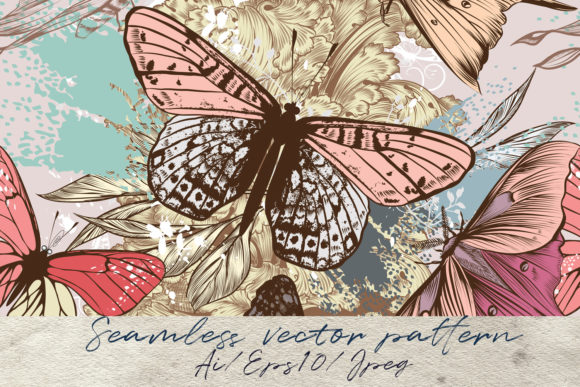
Imagine a delicate, hand-drawn butterfly—its wings layered with fine linework, subtle cross-hatching, and engraved retro charm—repeating seamlessly across fabric, stationery, or a wedding invitation. That’s the quiet power of a Fashion Vector Pattern with Butterflies: not just decoration, but a versatile, scalable foundation for thoughtful design. Created with precision and care, this collection features 100 high-detail vector motifs, each drawn by hand then converted to crisp, infinitely scalable vectors—preserving every nuance of texture and line without pixelation or loss of character.
Why This Pattern Resonates Beyond Aesthetics
This isn’t generic clipart. The engraved retro style evokes mid-century illustration techniques—think fine etching, soft shadow gradients, and intentional imperfections that suggest craftsmanship rather than automation. Designers choose it for projects where authenticity matters: luxury bridal suites, artisanal textile labels, boutique wallpaper installations, or editorial layouts needing warmth and narrative depth. Because it’s delivered in both vector (AI, EPS10) and raster (5000×5000 px JPEG preview) formats, you’re covered whether you’re prepping for large-format printing or sharing a mood board with a client.
A Common Misstep: Assuming “Vector” Means “Ready for Everything”
Many assume that because a file is labeled “vector,” it will behave predictably across all software and use cases. Not quite. Some designers download an EPS file only to discover it contains embedded raster elements—or worse, ungrouped layers that collapse when resized in Illustrator. Others open the AI file and find fonts substituted or strokes inconsistently applied, throwing off the engraved effect. These issues don’t reflect poor quality—they reflect incomplete preparation on the user’s end.
For example, one small-business owner used a butterfly motif directly from the JPEG preview for a silk scarf mockup—only to realize too late that scaling it up revealed visible pixelation and lost line integrity. The result? A costly rework and delayed product launch. The fix was simple: always start from the native AI or EPS10 file, verify stroke weights are set to 0.25–0.75 pt (ideal for engraved subtlety), and confirm all paths are outlined before exporting for print.
Overlooking Seamless Tiling—And Why It Matters
A truly seamless pattern means no visible edges or misaligned repeats. But not all “seamless” claims hold up at scale. Some collections rely on basic tile cloning that creates hard transitions between motifs—especially noticeable in large wallpaper applications or full-bleed fabric prints. With this Fashion Vector Pattern with Butterflies, each tile has been manually adjusted and stress-tested across multiple repeat sizes (12×12 in, 24×24 in, A4) to ensure smooth continuity. Before committing to production, zoom out to 10% view in Illustrator and pan slowly—you should see no rhythm breaks or visual “bumps.” If you do, the pattern wasn’t built for real-world application.
Confusing Detail with Complexity
High detail doesn’t mean high maintenance—if the vector is well-structured. Poorly organized files often group unrelated butterflies, merge clipping masks unnecessarily, or nest layers so deeply that editing one wing requires six clicks and three undo steps. That slows down iteration and increases error risk. In contrast, this collection uses logical layer naming (“Butterfly_038_SideView”, “Background_Dots”), consistent color groups (Pantone-compatible swatches included), and minimal compound paths—so swapping a single motif or adjusting spacing takes seconds, not minutes.
A freelance surface designer once spent four hours trying to isolate one butterfly from a dense cluster in another pack—only to find the entire composition was flattened into one path. With this set, every element is individually selectable, grouped meaningfully, and preserved as editable vectors—not flattened artwork masquerading as vector.
What to Check Before You Download or Purchase
- File structure: Open the AI sample (if available) and check whether layers are named, grouped intuitively, and free of hidden objects or stray points.
- Stroke vs. fill consistency: Engraved retro style relies on controlled line weight. Confirm strokes aren’t expanded unnecessarily—this preserves editability and ensures clean scaling.
- Color mode: For print use, CMYK compatibility matters. This collection includes both RGB (for screen) and CMYK-ready swatches—no last-minute conversion surprises.
- Preview fidelity: The JPEG preview should match the vector output in composition and density—not just approximate it. If the preview looks sparse or overly simplified, the vector may lack the promised detail.
- Licensing clarity: While personal and commercial use is included, verify whether extended licenses (e.g., for resale on POD platforms) require add-ons—some sellers bury restrictions in fine print.
Getting the Most Out of Your Purchase
Start small. Try one butterfly motif as a foil-stamped accent on a thank-you card before scaling to full wallpaper. Use the EPS10 version for compatibility with older design software or print service providers who still require legacy formats. And always save your working file with a new name before ungrouping—this preserves the original structure for future reuse.
If you're designing for fabric, test the pattern at actual print resolution (e.g., 150–300 PPI at final size) before sending to the mill. Many digital previews look sharp on screen but lose definition when rendered on linen or cotton. Likewise, for laser engraving on wood or acrylic, simplify fills and reinforce outlines—this set includes optional outline-only variants for exactly that purpose.
Final Thought: Quality Isn’t Just in the Lines—It’s in the Intent
A Fashion Vector Pattern with Butterflies done well reflects intention at every stage: how the wings curve, how shadows fall, how motifs interact across space. It respects both the craft of drawing and the practicalities of modern design workflows. When you choose a collection like this—one built for scalability, seamlessness, and sensitivity to material context—you’re not just licensing art. You’re investing in reliability, flexibility, and quiet confidence in every project you touch.