St.Patrick Pattern Collection: A Versatile Design Resource for Cultural Expression and Creative Workflow
The St.Patrick Pattern Collection is more than a seasonal toolkit—it’s a thoughtfully curated set of scalable, production-ready design assets rooted in the visual language of Irish heritage. Unlike generic holiday-themed graphics, this collection integrates authentic calligraphic nuance with repeatable pattern logic, making it equally valuable to branding professionals developing Saint Patrick’s Day campaigns, educators designing culturally responsive classroom materials, or independent crafters producing limited-edition merchandise. Its strength lies not in ornamentation alone, but in structural versatility: each element is engineered for real-world adaptability across print, web, embroidery, and digital illustration workflows.
Design Integrity Meets Practical Functionality
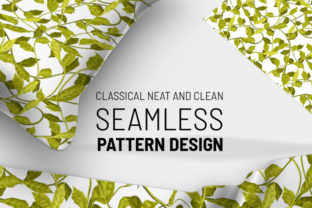
At its core, the St.Patrick Pattern Collection prioritizes fidelity without sacrificing flexibility. The five seamless patterns—rendered in both EPS (vector) and JPEG (raster) formats—feature interwoven motifs such as Celtic knots, shamrock clusters, harp silhouettes, and stylized clover vines. These are not static borders or isolated icons; they’re mathematically balanced repeats designed to tile flawlessly at any scale. A designer working on a large-format parade banner can enlarge a pattern to 300% without pixelation thanks to the vector EPS files. Meanwhile, a social media manager preparing Instagram Stories can drop the JPEG variants directly into Canva or Adobe Express, confident that resolution and color consistency remain intact across devices.
This dual-format approach reflects an understanding of how professionals actually work: vector files support precision editing in Illustrator or Affinity Designer, while high-resolution JPEGs serve fast-turnaround needs where file size and compatibility matter most. The inclusion of both ensures no user is excluded by software preference or technical constraints—a subtle but critical consideration for inclusive design practice.
Calligraphy That Communicates Meaning, Not Just Mood
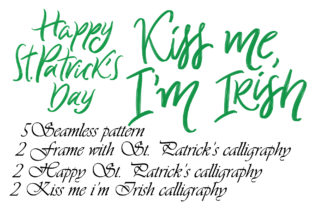
Two distinct “Happy St. Patrick” calligraphy compositions anchor the typographic dimension of the collection. Each exists in JPEG, EPS, and PNG formats—offering transparency options (PNG), scalability (EPS), and universal accessibility (JPEG). What sets these apart from typical script fonts is their intentional rhythm and cultural resonance. One composition leans into flowing, ribbon-like strokes reminiscent of illuminated manuscript traditions; the other adopts a bolder, slightly condensed structure optimized for legibility on apparel or signage.
These aren’t decorative flourishes applied after the fact—they function as compositional anchors. For example, an educator creating a bilingual Saint Patrick’s Day handout might layer the lighter calligraphy over a subtle background pattern to introduce visual hierarchy, then use the bolder version as a section header. A small-business owner launching a limited-run mug series could isolate the EPS version, convert strokes to outlines, and adjust kerning to fit curved surfaces precisely. The presence of PNG files with alpha channels further expands utility: they allow non-designers to drag-and-drop text elements into PowerPoint presentations or Google Slides without white-box artifacts.
“Kiss Me I’m Irish”: From Slogan to Strategic Asset
The two “Kiss Me I’m Irish” variations exemplify how the St.Patrick Pattern Collection transforms cliché into context-aware communication. Rather than presenting the phrase as a monolithic graphic, the set offers differentiated treatments—one playful and rounded, the other with sharper serifs and tighter spacing. Both are available in JPEG, EPS, and PNG, enabling users to match tone to audience. A pub owner designing a chalkboard menu may prefer the looser variant for its hand-painted warmth, while a university Irish Studies department promoting a lecture series might select the refined version to signal academic rigor alongside cultural celebration.
Crucially, these phrases are not locked into fixed layouts. Because they exist as editable vectors (EPS), users can extract individual letters, recolor glyphs to align with brand palettes, or integrate them into larger illustrated scenes—say, weaving the “K” and “I” into a Celtic knot frame. This modularity supports deeper creative engagement than static image libraries typically permit.
Framing Tradition with Modern Precision
The two included frame designs—supplied exclusively as EPS files—demonstrate how traditional Irish framing conventions translate into contemporary design systems. One evokes the ornate symmetry of Book of Kells marginalia, built from mirrored knotwork; the other adopts a minimalist circular motif centered around a harp, suitable for photo overlays or certificate borders. As vector assets, they retain infinite scalability and support Boolean operations: designers can subtract shapes to create cut-out effects for packaging die-lines, or combine them with gradients to simulate metallic foil stamping.
In educational contexts, these frames become teaching tools. A visual arts instructor might import the knotwork frame into a vector editor and guide students through path manipulation exercises—demonstrating how symmetry, repetition, and negative space operate in Celtic design logic. For researchers studying iconographic evolution, the frames offer clean, decontextualized references for comparative analysis against historical manuscripts.
Workflow Integration Across Disciplines
Real-world application reveals the collection’s breadth. Consider three distinct use cases:
- Product Development: A textile designer sourcing motifs for a spring scarf line imports the seamless patterns into Adobe Photoshop’s pattern fill engine, adjusts hue saturation to harmonize with existing fabric swatches, and exports tiled repeats at 300 DPI for mill submission.
- Educational Publishing: A curriculum developer building a K–5 cultural literacy unit exports the “Happy St. Patrick” PNG with transparency, places it over a photographed Dublin street scene, and adds speech bubbles in Gaeilge (Irish Gaelic) using the same font family—leveraging visual consistency to reinforce linguistic connection.
- Local Business Marketing: A bakery owner uses the “Kiss Me I’m Irish” EPS file to create a custom stencil, then airbrushes the phrase onto reusable kraft paper bags—blending artisanal authenticity with branded recognition.
Each scenario relies on format diversity, semantic coherence, and cultural accuracy—not just aesthetic appeal. That alignment between intention and execution is what distinguishes the St.Patrick Pattern Collection from disposable clip art.
Considerations for Ethical and Effective Use
While the collection provides robust technical foundations, responsible implementation requires contextual awareness. Saint Patrick’s Day carries layered significance: it is both a Christian feast day commemorating the patron saint of Ireland and a global cultural phenomenon often detached from its theological and historical roots. Users should consider audience, platform, and purpose. A healthcare organization sharing wellness tips with Irish-American communities might pair the harp frame with evidence-based content on mental health resources—using design to affirm identity without reducing culture to stereotype.
Similarly, educators should avoid presenting patterns or symbols in isolation. Pairing the St.Patrick Pattern Collection assets with primary sources—such as digitized pages from the Book of Kells or oral history interviews from Irish diaspora communities—grounds visual choices in lived experience. The collection does not replace research; it amplifies it.
Long-Term Value Beyond March 17
Though timed to Saint Patrick’s Day, the assets possess enduring utility. The seamless patterns function equally well as subtle backgrounds for quarterly financial reports (evoking stability and continuity), the calligraphy adapts to wedding invitations with minor color shifts, and the frames serve as elegant dividers in annual sustainability reports. Their longevity stems from restraint: no element overcommits to trend-driven aesthetics like neon green gradients or cartoon leprechauns. Instead, they rely on proportion, balance, and symbolic resonance—qualities that age gracefully in design systems.
For creators managing multiple clients or evolving personal brands, this timelessness translates to efficiency. Once licensed, the St.Patrick Pattern Collection becomes part of a reusable asset library—not a one-off purchase, but infrastructure. A freelance designer might build a standardized presentation template using the knotwork frame as a slide footer, embed the clover pattern as a watermark in proposal PDFs, and rotate between the two calligraphy styles depending on whether a project emphasizes celebration or scholarship.
In sum, the St.Patrick Pattern Collection succeeds by meeting users where they are: technically prepared, culturally grounded, and creatively empowered. It assumes competence rather than prescribing outcomes—offering not just files, but frameworks for meaningful expression.