Floral Pattern with Vintage Butterflies
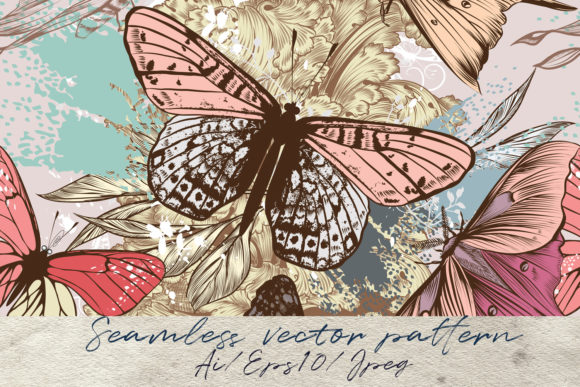
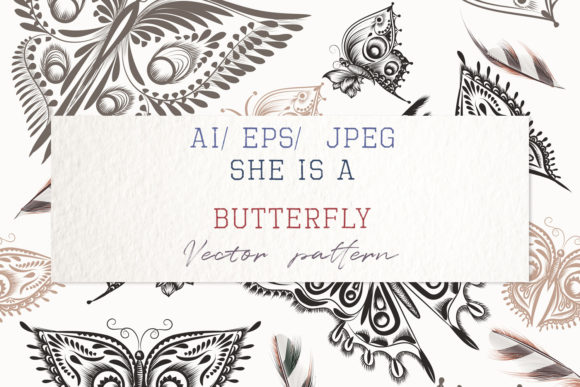
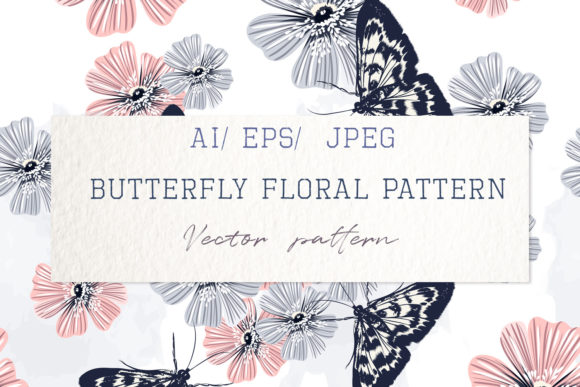
If you’ve ever spent hours adjusting a scanned floral motif only to watch it blur or pixelate at larger sizes—or struggled to match delicate vintage florals with authentic, hand-drawn butterflies—this Floral Pattern with Vintage Butterflies was designed for exactly that moment. It’s not just another repeat pattern; it’s a carefully balanced composition of 100 individually drawn vector elements: heirloom-style roses, faded lilacs, soft peonies, and translucent-winged butterflies rendered with subtle ink texture, gentle line variation, and intentional imperfection. Every petal, vein, and wing edge was crafted by hand—then translated into vector without losing its organic soul.
Why infinite scalability matters more than you think
When designing wedding stationery, a single invitation may need to scale from a 4×6” RSVP card to a 48×96” ceremony backdrop. Raster files break down long before that point. This Floral Pattern with Vintage Butterflies arrives in AI (CS2-compatible) and EPS10 formats—industry-standard vector containers that retain crispness at any size. You can stretch it across a silk scarf, emboss it onto letterpress paper, or project it onto a reception wall—and the fine linework on each butterfly’s wing remains legible, not aliased or softened. That fidelity saves time: no redrawing, no upscaling artifacts, no last-minute panic when a client requests a banner three times larger than planned.
Seamless integration—not just seamless tiling
The pattern repeats cleanly in both horizontal and vertical directions, but what makes it truly practical is how naturally the motifs interact across tile boundaries. Vintage butterflies don’t awkwardly clip mid-flight; stems curve gracefully across seams; blossoms overlap with intentional asymmetry—not algorithmic repetition. That means less manual patching in Illustrator or Photoshop. For fabric designers, this translates to faster sampling: upload directly to Spoonflower or Printful, preview full-yard repeats, and approve with confidence. For interior designers selecting wallpaper, it eliminates visual “jumps” at seam lines—critical in large-format residential or boutique hotel installations.
Real-world versatility, grounded in format flexibility
You receive three core assets: one editable Illustrator file (CS2), one universally compatible EPS10, and a high-res JPEG preview (5000×5000 px). That combination covers nearly every workflow. The AI file preserves layers, transparency, and editable strokes—ideal if you need to recolor individual blooms or isolate butterflies for custom monograms. The EPS10 opens reliably in Affinity Designer, CorelDRAW, and even older versions of InDesign—useful for print shops or collaborators using legacy software. And the JPEG isn’t just a placeholder: at 5000 px square, it’s sharp enough for mood boards, client presentations, or social mockups without loading delays.
Who benefits most—and why timing matters
Wedding professionals often juggle tight deadlines and highly personal aesthetics. A couple might love “vintage garden party” vibes but struggle to source cohesive elements—florals that feel antique, not generic; butterflies that suggest delicacy, not cartoonishness. This Floral Pattern with Vintage Butterflies bridges that gap. Use it as a base for save-the-dates, then extract single blooms for menu borders, or lift butterflies for wax seal illustrations—all from the same trusted source.
Fabric and surface designers appreciate how the 100-element count supports customization. You’re not locked into one density or rhythm. Want looser spacing for breathable linen? Delete select stems. Prefer denser coverage for upholstery? Duplicate and stagger layers. Because everything is vector, adjustments preserve proportion and texture—no raster-based warping or loss of detail.
Educators and workshop leaders find value in the balance of craftsmanship and accessibility. When teaching pattern design, this set demonstrates how hand-drawn authenticity coexists with technical precision. Students can study stroke weight transitions in petals, observe how negative space defines butterfly wings, and practice color separation—all within an editable, non-destructive file.
Thoughtful limitations—and when to look elsewhere
This Floral Pattern with Vintage Butterflies excels in warmth, subtlety, and tactile nuance—but it’s intentionally restrained in contrast and saturation. If your project demands bold, high-contrast graphics (e.g., streetwear branding or tech conference backdrops), the soft ink-like rendering may lack visual punch at a distance. Likewise, while the JPEG preview is high-resolution, it’s not intended for direct commercial printing—always use the vector files for production. And though the pattern is seamless, it’s not infinitely modular in the way some geometric tiles are; the organic flow means rotating or mirroring sections may require light adjustment to maintain natural rhythm.
Practical next steps for confident use
- Start small: Drop the JPEG into a Canva or Figma layout first—test how the scale feels against typography or photography before committing to vector edits.
- Leverage layer organization: In the AI file, blooms, leaves, and butterflies are grouped logically. Turn off background stems to emphasize butterflies for greeting cards—or hide butterflies entirely to focus on botanicals for herbal product labels.
- Respect the hand-drawn voice: Avoid over-saturating colors or applying heavy gradients. These motifs shine when treated with restraint—think muted sage, parchment, dusty rose, or charcoal grey rather than neon or metallics.
- Check your output context: For fabric printing, confirm DPI requirements with your vendor—vector eliminates scaling risk, but color profiles (CMYK vs. RGB) still matter. For web use, export SVGs from the AI file for lightweight, responsive backgrounds.
This Floral Pattern with Vintage Butterflies doesn’t try to be everything. It’s focused: deeply detailed, quietly elegant, technically robust, and rooted in analog craft. It helps creators spend less time troubleshooting resolution or sourcing mismatched assets—and more time refining meaning, tone, and intention. Whether you’re hand-lettering vows onto vellum, developing a textile line for slow fashion brands, or designing a quiet, nature-infused learning space for children, the consistency and care embedded in these 100 vector elements become part of your own creative reliability.