Tropical Vector Seamless Pattern
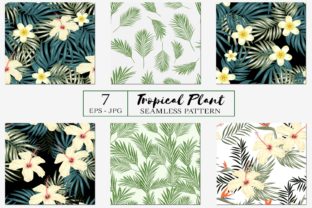
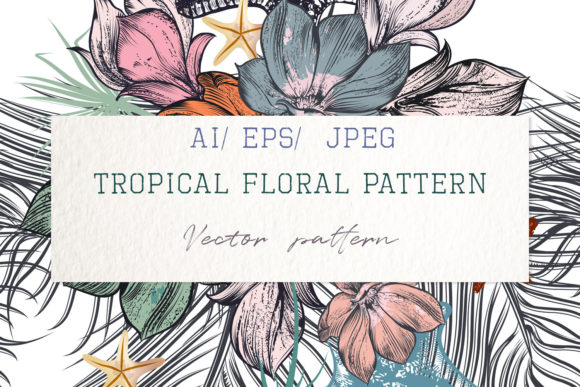
If you’ve ever spent hours trying to scale a hand-drawn botanical motif only to watch it blur, pixelate, or lose its organic warmth—this is the solution you’ve been looking for. The Tropical Vector Seamless Pattern isn’t just another clipart pack. It’s a carefully crafted, high-fidelity collection of 100 vector illustrations featuring hand-drawn tropical palm leaves and magnolia flowers—designed from the ground up to retain expressive linework, subtle texture, and natural asymmetry at any size.
Why “Seamless” Matters More Than You Think
A truly seamless pattern doesn’t just tile—it breathes. Unlike raster-based repeats that reveal hard edges or alignment glitches when enlarged, this Tropical Vector Seamless Pattern uses precise vector anchoring and balanced negative space so motifs flow across surfaces without visual breaks. That means whether you’re wrapping a 48-inch wedding invitation suite or covering an entire feature wall with wallpaper, the rhythm stays consistent. No manual cloning. No awkward gaps. Just quiet, confident repetition.
This matters especially in print-heavy contexts: fabric designers avoid costly sampling delays when patterns align flawlessly on bolt rolls; stationery creators eliminate last-minute reflows when scaling from business card to thank-you postcard; interior stylists confidently project how a motif will behave across a 12-foot sofa cushion set. Seamlessness here isn’t theoretical—it’s engineered into every anchor point and curve.
Hand-Drawn Detail, Not Just Hand-Drawn Style
Many “hand-drawn” assets rely on brush effects layered over geometric shapes—giving the impression of imperfection without the authenticity. This Tropical Vector Seamless Pattern starts with actual ink-on-paper studies. Each palm frond shows deliberate tapering, slight tremor in mid-stem lines, and nuanced leaf veining that varies by species. Magnolias bloom with asymmetrical petal overlap, stamen clusters drawn individually—not duplicated—and delicate bud forms that suggest growth stage. These aren’t decorative flourishes; they’re observational choices that lend credibility to your design.
For educators illustrating botany concepts, that specificity supports learning. For wedding planners curating a “coastal elegance” aesthetic, it avoids the flatness of generic tropics. And for small-batch textile printers, those details translate directly into richer screen-printed texture—no extra trapping or overprinting needed.
Vector Flexibility Without Compromise
The included AiCS2 and EPS10 files aren’t just scalable—they’re editable at the path level. Want to isolate a single magnolia to use as a monogram centerpiece? Adjust stroke weight on palm stems to match your brand’s typographic hierarchy? Recolor leaves using global swatches instead of hunting through layers? All possible—without flattening or rasterizing.
That flexibility saves time in real-world workflows. A freelance graphic designer building a client’s full brand toolkit can extract individual motifs for social avatars, email headers, and packaging labels—all from one source file. A blogger creating printable party kits can resize a corner motif for a 5×7 inch favor tag or stretch the full repeat across a 24×36 inch poster—same fidelity, zero rework.
The 5000×5000 px JPEG preview isn’t just for quick viewing. Its resolution lets you assess color balance, motif density, and contrast under real lighting conditions—helpful before committing to large-format printing or fabric dye testing.
Practical Use Cases—Where This Pattern Earns Its Place
- Wedding Designers: Build cohesive suites where the same palm-and-magnolia rhythm appears on save-the-dates, ceremony programs, napkin prints, and cake toppers—without licensing conflicts or mismatched scales.
- Fabric & Surface Designers: Import directly into textile CAD software (like NedGraphics or Kaledo) for repeat analysis, colorway iteration, or DPI-adjusted output for digital textile printing.
- Educators & Content Creators: Use isolated elements to illustrate plant anatomy, climate zones, or cultural symbolism—retaining educational accuracy while keeping visuals engaging.
- Small Business Owners: Apply the pattern to Shopify store banners, product labels, or packaging inserts with confidence—no pixelation on retina displays or printed hang tags.
Who Benefits Most—and When to Consider Alternatives
This Tropical Vector Seamless Pattern shines for professionals who value both artistic integrity and production reliability. If your work involves frequent resizing, multi-surface application, or collaboration with printers and developers, the vector foundation pays off immediately.
It’s less ideal if you need photorealistic foliage (this leans expressive, not botanical-photographic) or require animated variants (it’s static vector art, not motion-ready). Also, while the palette is warm and versatile—creamy whites, soft sage, warm sand—it’s delivered in editable CMYK/RGB swatches, not pre-separated Pantones. Users needing exact brand-color matching should plan for minor calibration during prep.
For hobbyists exploring surface design, the learning curve is gentle: Illustrator users can start with the AiCS2 file and use Live Paint Bucket to recolor sections intuitively. Affinity Designer or CorelDRAW users can open EPS10 with full layer integrity—just confirm your version supports legacy EPS embedding.
Thoughtful Integration, Not Just Decoration
What makes this more than a “pretty background” is how thoughtfully the elements interact. Palm leaves curve *away* from magnolia blooms—not toward them—creating implied movement rather than static symmetry. Spacing between motifs allows breathing room for text overlays or photography integration. Even the line weights shift intentionally: thicker trunks ground the composition, while finer petal outlines invite closer inspection.
That intentionality supports stronger communication. A wellness brand using this pattern on meditation journal covers signals calm, grounded growth—not generic “vacation vibes.” A boutique hotel applying it to bathrobes and lobby wallpaper evokes curated hospitality, not mass-market resort clichés.
And because all 100 vector illustrations are built on the same stylistic grammar—consistent pressure variation, shared baseline curvature, harmonized scale ratios—you can mix and match motifs across projects without visual whiplash. That cohesion saves decision fatigue when building long-term visual systems.
A Resource That Grows With Your Work
You don’t need to use the full seamless repeat to benefit. Extract one magnolia cluster for a logo lockup. Trace a single palm silhouette for a custom icon set. Layer two motifs in different opacities for depth in a presentation slide. The value isn’t locked in the pattern—it’s distributed across every editable node, stroke, and swatch.
That’s why designers return to this Tropical Vector Seamless Pattern across seasons and projects: it adapts without asking you to compromise your standards. Whether you’re launching a new product line, designing a one-off event, or building a signature aesthetic over years—the hand-drawn authenticity stays legible, the vector precision stays dependable, and the tropical warmth stays quietly sophisticated.