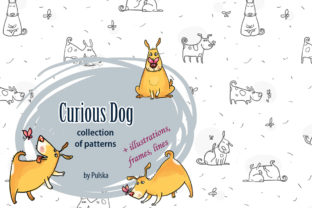
Curious Dog Collection
The Curious Dog Collection is a curated set of digital design assets centered on playful, illustrated motifs featuring dogs interacting with butterflies. As the first installment in a broader dog-themed series, it emphasizes curiosity, light-hearted charm, and visual versatility. This collection is not a single image or template but a structured set of repeatable patterns and standalone frames—designed for practical reuse across multiple creative applications.
At its core, the collection includes five distinct seamless patterns, each rendered in five color variations. These patterns feature the “Curious Dog” motif arranged across two horizontal lines—ideal for textile repeats, website backgrounds, or wallpaper designs. In addition, seven frame-style illustrations depict three dogs alongside a butterfly, offering compositional flexibility for postcards, social media graphics, or print layouts. Two of these frames are adapted into dedicated pattern formats, and one is presented as a pink-toned variant tailored toward feminine or youth-oriented aesthetics.
All assets are delivered in multiple industry-standard formats: EPS (vector, scalable without quality loss), PNG (transparent background, high-resolution raster), and JPG (widely compatible, RGB color space). Every file is output at 300 DPI—meeting professional print requirements—and organized to support both digital and physical production workflows.
Who Might Find Value in the Curious Dog Collection?
Designers, small-business owners, educators, and hobbyists often seek cohesive, ready-to-use visual elements that convey warmth and approachability without requiring custom illustration work. The Curious Dog Collection suits users who need consistent branding elements—such as repeating backgrounds for fabric, subtle UI textures, or themed screen savers—for projects where tone matters as much as function.
For example, a children’s book publisher evaluating illustration styles may compare this collection against hand-drawn alternatives to assess scalability and stylistic alignment. A boutique clothing brand exploring seasonal textile prints could test how the five-color pattern set translates across cotton jersey or linen—especially given the inclusion of vector EPS files that allow for precise resizing and recoloring.
Practical Benefits and Realistic Tradeoffs
One clear benefit is format diversity. Having EPS, PNG, and JPG versions means users can adapt assets across contexts: EPS for cutting machines or vector-based layout tools; PNG for web use with transparency; JPG for quick embedding where file size and compatibility take priority. The 300 DPI resolution ensures fidelity in printed materials such as greeting cards or fabric swatches—provided the original dimensions are respected during scaling.
However, the collection’s scope is intentionally narrow. It does not include editable layers beyond what’s supplied in the PSD files (which contain only the seven frame illustrations—not the patterns). Users seeking full layer control over pattern components (e.g., isolating individual dogs or adjusting butterfly placement within a tile) will find limited flexibility, as the patterns are delivered as flattened raster and vector repeats. Similarly, while color variants exist, they are pre-selected—not algorithmically generated—so customization beyond those five palettes requires manual editing.
Another consideration is stylistic specificity. The illustrations follow a clean, semi-flat aesthetic with soft outlines and gentle shading. That works well for modern, friendly branding—but may not suit projects calling for realism, maximalism, or highly detailed linework. Users comparing this to other dog-themed asset packs should evaluate whether the “curious” expression and butterfly motif align with their intended emotional resonance.
When This Collection Is a Strong Fit
The Curious Dog Collection performs best in scenarios where consistency, thematic cohesion, and production efficiency are priorities. It is particularly well-suited for:
- Textile designers developing coordinated fabric lines for babywear, pet accessories, or home goods;
- Web designers building child- or pet-focused sites who need lightweight, thematically unified background textures;
- Print-on-demand creators producing themed stationery—especially postcards and greeting cards—where the included frames and patterns offer immediate layout options;
- Educators or therapists designing visual aids or reward charts for young learners, where recognizable, non-threatening animal imagery supports engagement.
In each case, the value lies less in novelty and more in reliability: knowing that all assets share a common visual language, consistent resolution, and cross-format usability reduces testing time and version-control overhead.
When Alternatives May Be Worth Exploring
Users with specific technical needs may find limitations. For instance, if a project requires SVG exports for responsive web use—or animated versions for interactive interfaces—the absence of those formats means additional conversion effort. Similarly, designers working exclusively in Figma or Sketch may prefer native file types over PSD/EPS, necessitating import adjustments or third-party conversion tools.
Those needing broader thematic variety—such as seasonal variations (e.g., dogs with snowflakes or autumn leaves), diverse breeds, or inclusive human-animal interactions—may find the current scope too focused. Other collections might offer modular components (separate dog, butterfly, and accessory layers) for greater compositional control. Likewise, illustrators aiming to build custom derivatives may prefer open-source or CC0-licensed assets that permit unrestricted modification—whereas licensing terms for this collection (not specified here) should be verified before commercial redistribution or derivative publishing.
Making an Informed Decision
Before acquiring the Curious Dog Collection, consider three practical checkpoints:
- Intended Use Case: Does your project rely on repeatable patterns, framed illustrations, or both? If you only need one type—say, frames for social media banners—the pattern count may be secondary.
- Workflow Compatibility: Do your primary tools support EPS and PSD natively? If you rely heavily on browser-based editors or mobile apps, verify whether PNG/JPG versions meet your quality and transparency needs.
- Stylistic Alignment: Compare sample visuals against your brand guidelines or audience expectations. Does the balance of simplicity and expressiveness match your communication goals—or would a bolder, more stylized, or more naturalistic approach serve better?
Finally, remember that digital asset collections are tools—not solutions. Their usefulness emerges from how well they integrate into existing processes and complement other resources. The Curious Dog Collection offers a focused, production-ready starting point—not a comprehensive design system. Evaluating it alongside your actual constraints (time, skill, platform, audience) yields clearer insight than assessing it in isolation.