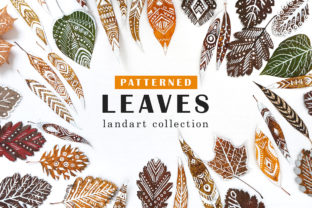
Patterned Leaves - Landart Collection
Patterned Leaves - Landart Collection is not just another digital asset pack. It’s a curated set of 55 dried autumn leaves—each individually selected, naturally preserved, hand-painted with ethnic motifs, and meticulously digitized to retain realistic texture, subtle imperfections, and organic nuance. Accompanying the leaves are 16 high-resolution background photos—designed for immediate integration into real-world creative workflows. This isn’t decorative filler. It’s a tactile, culturally grounded visual resource built for intentionality.
Why Strategic Selection Matters More Than Volume
Most designers reach for pattern libraries based on speed or trend alignment. Patterned Leaves - Landart Collection invites a different approach: one rooted in material authenticity and cultural resonance. Each leaf carries its own ornament—no repeats, no algorithmic duplication. That means every element has inherent narrative weight. When you choose a leaf with a Berber-inspired geometric border over one with a stylized Māori koru motif, you’re not just picking a shape—you’re signaling tone, context, and values. That distinction matters most when building brand identity, crafting educational materials, or designing customer-facing touchpoints where emotional coherence drives trust.
For small business owners launching artisanal packaging—or educators developing cross-cultural lesson visuals—the specificity of these patterns supports clarity of intent. Randomly applied ornamentation can dilute messaging; thoughtfully matched motifs reinforce it. The collection’s realism—veins visible, edges slightly curled, pigment settling into natural grooves—adds credibility that flat vector patterns often lack. In an era where audiences increasingly value craft and provenance, this authenticity becomes operational leverage—not just aesthetic preference.
Where Patterned Leaves - Landart Collection Delivers Measurable Value
This collection excels where digital design intersects with human perception and physical experience. Consider these practical applications:
- Digital scrapbooking and card design: Because each leaf retains dimensional texture, overlays behave more naturally under lighting effects or layer blending modes—reducing post-production time spent faking depth.
- Interior decoration mockups: The 16 included backgrounds (shot in natural light, neutral palettes, varied compositions) serve as ready-made environments for presenting wall art, framed prints, or shelf displays—critical for cafes, boutique retailers, or home stylists pitching concepts to clients.
- Craft product branding: Handmade soap labels, ceramic studio newsletters, or yarn shop social posts gain instant warmth when paired with a leaf bearing a hand-painted Adinkra symbol—without needing custom illustration.
- Educational and editorial use: Teachers illustrating seasonal biology units or publishers designing nonfiction book covers benefit from scientifically accurate leaf morphology fused with culturally specific patterning—supporting both accuracy and inclusivity.
What separates Patterned Leaves - Landart Collection from generic foliage assets is its built-in decision architecture. You don’t start from zero. You begin with constraints that sharpen focus: limited quantity (55), intentional variation (ethnic motifs), and physical fidelity (real texture, real imperfection). That structure reduces choice fatigue—and directs attention toward *how* a given leaf serves your objective, not just whether it looks “nice.”
Using the Collection With Purpose—Not Just Convenience
Intentional use starts before opening the folder. Ask: What outcome am I trying to support? A café rebrand? Then prioritize leaves with warm-toned pigments and open, airy backgrounds that suggest hospitality—not dense, high-contrast motifs that evoke intensity. A mindfulness app UI refresh? Select leaves with flowing, repetitive line work and soft gradients to reinforce calm pacing.
Also consider scale and hierarchy. A single leaf works powerfully as a focal point on a greeting card or Instagram story—but scaled down across a repeating pattern, its uniqueness risks flattening into noise. That’s why the included backgrounds matter: they offer compositional anchors. Use them to establish mood first, then place a leaf deliberately—not as decoration, but as punctuation.
Test contrast early. These leaves were photographed with natural light, meaning their midtones sit closer to real-world paper or wood than to screen-bright vectors. If your project demands high legibility (e.g., packaging text overlays), preview typography against actual leaf scans—not thumbnails. Adjust opacity or add subtle drop shadows only where needed to preserve readability without sacrificing texture.
Risks of Misalignment—And How to Avoid Them
The biggest risk isn’t technical—it’s contextual. Applying a Navajo-inspired zigzag motif to a product unrelated to Indigenous craft traditions, without understanding its significance, introduces reputational and ethical exposure. Patterned Leaves - Landart Collection includes diverse ethnic patterns precisely because they carry meaning—not as stylistic garnish, but as cultural reference points. Using them requires basic due diligence: a quick search into motif origins, respectful attribution where appropriate, and awareness of appropriation red flags (e.g., sacred symbols used out of context).
Another common misstep: over-relying on novelty. A leaf with intricate henna-style linework may captivate initially—but if it competes visually with core content or distracts from a call-to-action, its strategic value drops to zero. Evaluate each use case against function first: Does this leaf clarify, support, or enhance the user’s next step—or does it merely occupy space?
Long-Term Utility Beyond the First Project
Unlike trend-dependent assets that date quickly, Patterned Leaves - Landart Collection gains value over time through reuse and reinterpretation. A leaf painted with Ukrainian vyshyvanka embroidery might anchor a holiday card series one season—and become part of a textile design course syllabus the next. Its durability lies in its duality: botanical realism grounds it in the familiar; hand-applied ornament invites reinterpretation.
For freelancers and agencies, this collection functions as a subtle differentiator. Clients notice when presentation decks include textured, culturally informed elements—not because they name the pattern, but because the work feels considered, layered, and human-scaled. That perception builds credibility faster than any portfolio description.
For educators and creators documenting process—say, filming a workshop on sustainable material sourcing—the scanned leaves serve as tangible evidence of craft ethics: no AI generation, no stock shortcuts, just documented labor and respect for natural form. That integrity resonates across generations of learners and collaborators.
Getting Started Without Overcomplicating It
You don’t need a full strategy document to begin. Start with one constraint: Use only three leaves per project. That forces curation over accumulation. Next, assign each leaf a role: one as structural anchor (e.g., framing a quote), one as tonal guide (e.g., setting color palette via pigment), and one as narrative cue (e.g., reinforcing theme through motif). Revisit that framework quarterly—refining which leaves align with evolving goals.
Store the background photos separately from the leaf files. Treat them as environmental context, not decoration. When designing a client’s e-commerce banner, pick the background first—then select a leaf that complements its light direction and spatial rhythm. That sequence reinforces intentionality at the workflow level.
Finally, track usage. Note which leaves consistently perform well in specific contexts (e.g., “Leaf #27 used in 4 successful packaging mockups”). Patterns emerge—not in the artwork itself, but in how your decisions interact with it. That insight is where Patterned Leaves - Landart Collection transitions from tool to strategic partner.